Primal Water an Exhibition of Japanese Contemporary Art 7 De Julho
| Yayoi Kusama | |
|---|---|
 Kusama in 2016 | |
| Born | Yayoi Kusama (草間 彌生) (1929-03-22) 22 March 1929 Matsumoto, Nagano, Empire of Nihon |
| Nationality | Japanese |
| Known for |
|
| Motility |
|
| Awards | Praemium Imperiale |
| Website | www |
Yayoi Kusama ( 草間 彌生 , Kusama Yayoi , born 22 March 1929) is a Japanese contemporary creative person who works primarily in sculpture and installation, but is besides active in painting, performance, video fine art, way, poesy, fiction, and other arts. Her work is based in conceptual art and shows some attributes of feminism, minimalism, surrealism, Art Brut, pop art, and abstract expressionism, and is infused with autobiographical, psychological, and sexual content. She has been acknowledged as one of the most important living artists to come up out of Japan.[1]
Kusama was raised in Matsumoto, and trained at the Kyoto City University of Arts in a traditional Japanese painting style chosen nihonga.[ii] Kusama was inspired, however, by American Abstruse impressionism. She moved to New York City in 1958 and was a function of the New York advanced scene throughout the 1960s, especially in the popular-art move.[three] Embracing the ascent of the hippie counterculture of the late 1960s, she came to public attending when she organized a series of happenings in which naked participants were painted with brightly coloured polka dots.[4] [v] Since the 1970s, Kusama has continued to create art, about notably installations in various museums effectually the world.[half-dozen]
Kusama has been open about her mental health. She says that art has become her way to express her mental problems.[vii] She reported in the interview she did with Infinity Net "I fight pain, feet, and fear every day, and the only method I accept found that relieved my illness is to keep creating art. I followed the thread of fine art and somehow discovered a path that would allow me to live."[8]
Biography [edit]
Early life: 1929–1949 [edit]
Yayoi Kusama was built-in on 22 March 1929 in Matsumoto, Nagano.[9] Born into a family unit of merchants who owned a constitute plant nursery and seed farm,[10] Kusama began cartoon pictures of pumpkins in elementary school and created artwork she saw from hallucinations, works of which would subsequently define her career.[7] Her mother was not supportive of her creative endeavors; Kusama would blitz to finish her art because her mother would take it away to discourage her.[eleven] Her female parent was also plainly physically calumniating,[12] and Kusama remembers her begetter every bit "the type who would play effectually, who would womanize a lot".[10] The artist says that her female parent would oftentimes send her to spy on her male parent's extramarital affairs, which instilled within her a lifelong contempt for sexuality, particularly the male person'due south lower torso and the phallus: "I don't like sex activity. I had an obsession with sex. When I was a child, my male parent had lovers and I experienced seeing him. My mother sent me to spy on him. I didn't desire to have sex with anyone for years [...] The sexual obsession and fright of sex sit adjacent in me."[thirteen] Her traumatic childhood, including her fantastic visions, can be said to be the origin of her creative style.[xiv]
When Kusama was 10 years old, she began to experience brilliant hallucinations which she has described as "flashes of light, auras, or dumbo fields of dots".[15] These hallucinations too included flowers that spoke to Kusama, and patterns in fabric that she stared at coming to life, multiplying, and engulfing or expunging her,[xvi] a process which she has carried into her creative career and which she calls "self-obliteration".[17] Kusama'south fine art became her escape from her family unit and her own mind when she began to have hallucinations.[11] She was reportedly fascinated by the smooth white stones roofing the bed of the river near her family dwelling, which she cites as another of the seminal influences behind her lasting fixation on dots.[18]
When Kusama was 13, she was sent to piece of work in a military factory where she was tasked with sewing and fabricating parachutes for the Japanese army, and then embroiled in World War 2.[i] Discussing her time in the factory, she says that she spent her adolescence "in closed darkness" although she could e'er hear the air-raid alerts going off and come across American B-29s flying overhead in broad daylight.[1] Her babyhood was greatly influenced by the events of the state of war, and she claims that it was during this period that she began to value notions of personal and artistic liberty.[eighteen]
She went on to report Nihonga painting at the Kyoto Municipal School of Craft in 1948.[19] Frustrated with this distinctly Japanese style, she became interested in the European and American advanced, staging several solo exhibitions of her paintings in Matsumoto and Tokyo in the 1950s.[20]
Early on success in Nippon: 1950–1956 [edit]
By 1950, she was depicting abstract natural forms in h2o colour, gouache, and oil paint, primarily on newspaper. She began covering surfaces—walls, floors, canvases, and later, household objects, and naked assistants—with the polka dots that would become a trademark of her work.
The vast fields of polka dots, or "infinity nets", as she chosen them, were taken directly from her hallucinations. The earliest recorded work in which she incorporated these dots was a drawing in 1939 at historic period ten, in which the image of a Japanese adult female in a kimono, presumed to be the artist's female parent, is covered and obliterated past spots.[21] Her first series of big-scale, sometimes more than than 30 ft-long canvass paintings,[22] Infinity Nets, were entirely covered in a sequence of nets and dots that alluded to hallucinatory visions.
On her 1954 painting Flower (D.S.P.S) Kusama has said:
Ane day I was looking at the red blossom patterns of the tablecloth on a table, and when I looked upwards I saw the same blueprint covering the ceiling, the windows, and the walls, and finally all over the room, my torso and the universe. I felt equally if I had begun to self-obliterate, to revolve in the infinity of endless fourth dimension and the absoluteness of infinite, and be reduced to nothingness. As I realised it was actually happening and not but in my imagination, I was frightened. I knew I had to run away lest I should be deprived of my life by the spell of the red flowers. I ran desperately up the stairs. The steps below me began to fall apart and I savage down the stairs spraining my ankle.[23]
New York Urban center: 1957–1972 [edit]

An Infinity Room installation
Later living in Tokyo and French republic, Kusama left Japan at the age of 27 for the United states of america. She has stated that she began to consider Japanese gild "too small, as well servile, also feudalistic, and too scornful of women".[xv] Before leaving Nippon to the Usa, she destroyed many of her early works.[24] In 1957, she moved to Seattle, where she had an exhibition of paintings at the Zoe Dusanne Gallery.[25] She stayed in that location for a year[xvi] before moving on to New York Metropolis, following correspondence with Georgia O'Keeffe in which she professed an involvement in joining the limelight of the city, and sought O'Keeffe'due south advice.[26] During her time in the Us, she speedily established her reputation equally a leader in the avant-garde motility and received praise for her work from the anarchist art critic Herbert Read.[27]
In 1961 she moved her studio into the same building as Donald Judd and sculptor Eva Hesse; Hesse became a close friend.[28] In the early on 1960s Kusama began to create and so-chosen soft sculptures by covering items such equally ladders, shoes and chairs with white phallic protrusions.[29] Despite the micromanaged intricacy of the drawings, she turned them out fast and in bulk, establishing a rhythm of productivity which she all the same maintains. She established other habits too, like having herself routinely photographed with new work[16] and regularly appearing in public wearing her signature bob wigs and colorful, avant-garde fashions.[13]
A polka-dot has the form of the sun, which is a symbol of the free energy of the whole world and our living life, and also the grade of the moon, which is calm. Round, soft, colorful, senseless and unknowing. Polka-dots become move ... Polka dots are a way to infinity.
—Yayoi Kusama, in Manhattan Suicide Addict[thirty]
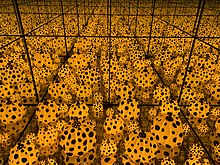
Since 1963, Kusama has connected her series of Mirror/Infinity rooms. In these circuitous infinity mirror installations, purpose-built rooms lined with mirrored glass contain scores of neon-colored balls, hanging at various heights to a higher place the viewer. Continuing inside on a small platform, an observer sees low-cal repeatedly reflected off the mirrored surfaces to create the illusion of a never-ending space.[31]
During the following years, Kusama was enormously productive, and by 1966 she was experimenting with room-size, freestanding installations that incorporated mirrors, lights, and piped-in music. She counted Judd and Joseph Cornell among her friends and supporters. Nevertheless, she did not profit financially from her piece of work. Around this time, Kusama was hospitalized regularly from overwork, and O'Keeffe persuaded her own dealer Edith Herbert to purchase several works to aid Kusama stave off fiscal hardship.[19] She was non able to brand the money she believed she deserved, and her frustration became and so extreme that she attempted suicide.[11]
In the 1960s, Kusama organized outlandish happenings in conspicuous spots like Fundamental Park and the Brooklyn Span, frequently involving nudity and designed to protestation the Vietnam War. In one, she wrote an open letter to Richard Nixon offer to have sexual practice with him if he would stop the Vietnam war.[22] Between 1967 and 1969 she concentrated on performances held with the maximum publicity, usually involving Kusama painting polka dots on her naked performers, every bit in the Grand Orgy to Awaken the Dead at the MoMA (1969), which took place at the Sculpture Garden of the Museum of Mod Art.[29] During the unannounced event, 8 performers under Kusama'southward direction removed their vesture, stepped nude into a fountain, and causeless poses mimicking the nearby sculptures by Picasso, Giacometti, and Maillol.[32]
In 1968, Kusama presided over the happening Homosexual Wedding at the Church building of Self-obliteration at 33 Walker Street in New York and performed alongside Fleetwood Mac and State Joe and the Fish at the Fillmore East in New York City.[19] She opened naked painting studios and a gay social lodge called the Kusama 'Omophile Kompany (kok).[33] The nudity present in Kusama's art and fine art protests was severely shameful for her family. This made her feel alone, and she attempted suicide again.[11]
In 1966, Kusama first participated in the Venice Biennale for its 33rd edition. Her Narcissus Garden comprised hundreds of mirrored spheres outdoors in what she called a "kinetic carpeting". Every bit soon equally the slice was installed on a backyard outside the Italian pavilion, Kusama, dressed in a golden kimono,[22] began selling each individual sphere for 1,200 lire (The states$2), until the Biennale organizers put an cease to her enterprise. Narcissus Garden was equally much about the promotion of the artist through the media as it was an opportunity to offer a critique of the mechanization and commodification of the art market.[34]
During her time in New York, Kusama had a brief relationship with creative person Donald Judd.[35] She then began a passionate, but platonic, relationship with the surrealist artist Joseph Cornell. She was 26 years his inferior – they would call each other daily, sketch each other, and he would transport personalized collages to her. Their lengthy association would last until his death in 1972.[35]
Render to Japan: 1973–1977 [edit]

In 1973, Kusama returned in ill health to Nihon, where she began writing shockingly visceral and surrealistic novels, short stories, and poetry. In 1977, Kusama checked herself into a hospital for the mentally ill, where she eventually took upward permanent residence. She has been living at the hospital since, by choice.[36] Her studio, where she has continued to produce piece of work since the mid-1970s, is a short distance from the infirmary in Tokyo.[37] Kusama is ofttimes quoted every bit saying: "If it were not for fine art, I would accept killed myself a long time ago."[38]
From this base, she has continued to produce artworks in a variety of media, too as launching a literary career past publishing several novels, a verse collection, and an autobiography.[12] Her painting style shifted to high-colored acrylics on canvas, on an amped-up scale.[16]
Revival: 1980s–present [edit]
Her organically abstract paintings of i or ii colors (the Infinity Nets serial), which she began upon arriving in New York, garnered comparisons to the work of Jackson Pollock, Marking Rothko, and Barnett Newman. When she left New York she was practically forgotten as an artist until the late 1980s and 1990s, when a number of retrospectives revived international interest.[39] Yayoi Kusama: A Retrospective was the offset critical survey of Yayoi Kusama presented at the Middle for International Gimmicky Arts (CICA) in New York in 1989, and was organized past Alexandra Munroe.[twoscore] [41]
Following the success of the Japanese pavilion at the Venice Biennale in 1993, a dazzling mirrored room filled with small-scale pumpkin sculptures in which she resided in color-coordinated magician's attire, Kusama went on to produce a huge, yellowish pumpkin sculpture covered with an optical pattern of black spots. The pumpkin came to represent for her a kind of alter-ego or cocky-portrait.[42] Kusama's later installation I'k Hither, simply Nothing (2000–2008) is a only furnished room consisting of tabular array and chairs, place settings and bottles, armchairs and rugs, still its walls are tattooed with hundreds of fluorescent polka dots glowing in the UV light. The effect is an countless infinite infinite where the self and everything in the room is obliterated.[43]

Narcissus Garden (2009), Instituto Inhotim, Brumadinho, Brazil
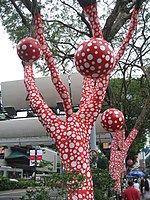
The multi-part floating work Guidepost to the New Infinite, a series of rounded "humps" in fire-engine red with white polka dots, was displayed in Pandanus Lake. Perhaps one of Kusama's about notorious works, various versions of Narcissus Garden have been presented worldwide venues including Le Consortium, Dijon, 2000; Kunstverein Braunschweig, 2003; as part of the Whitney Biennial in Central Park, New York in 2004; and at the Jardin de Tuileries in Paris, 2010.[44]
In her ninth decade, Kusama has continued to work as an artist. She has harkened dorsum to earlier work past returning to cartoon and painting; her work remained innovative and multi-disciplinary, and a 2012 exhibition displayed multiple acrylic-on-canvas works. Too featured was an exploration of infinite space in her Infinity Mirror rooms. These typically involve a cube-shaped room lined in mirrors, with water on the floor and flickering lights; these features suggest a pattern of life and death.[45]
In 2015-2016 the showtime retrospective exhibition in Scandinavia, curated by Marie Laurberg, travelled to four major museums in the region, opening at Louisiana Museum of Modern Art in Denmark and continuing to Henie Onstad Kunstsenter Museum, Norway, Moderna Museet in Sweden, and Helsinki Art Museum in Republic of finland. This major testify contained more than 100 objects and big scale mirror room installations. Information technology presented several early works that had not been shown to the public since they were get-go created, including a presentation of Kusama's experimental mode design from the 1960s.
In 2017, a l-year retrospective of her work opened at the Hirshhorn Museum in Washington, DC. The showroom featured half dozen Infinity Mirror rooms, and was scheduled to travel to 5 museums in the Usa and Canada.[46] [47]
On 25 Feb 2017, Kusama's All the Eternal Love I Have for the Pumpkins exhibit, 1 of the six components to her Infinity Mirror rooms at the Hirshhorn Museum, was temporarily closed for three days following damage to one of the exhibit's glowing pumpkin sculptures. The room, which measures 13 square feet (i.2 mtwo) and was filled with over 60 pumpkin sculptures, was i of the museum's most pop attractions ever. Allison Peck, a spokeswoman for the Hirshhorn, said in an interview that the museum "has never had a evidence with that kind of visitor demand", with the room averaging more than than 8,000 visitors betwixt its opening and the date of its temporary endmost. While there were conflicting media reports about the cost of the damaged sculpture and how exactly information technology was broken, Allison Peck stated that "there is no intrinsic value to the individual slice. It is a manufactured component to a larger piece." The exhibit was reconfigured to brand upwardly for the missing sculpture, and a new ane was to exist produced for the exhibit past Kusama.[48] The Infinity Mirrors exhibit became a sensation amidst art critics as well as on social media. Museum visitors shared 34,000 images of the exhibition to their Instagram accounts, and social media posts using the hashtag #InfiniteKusama garnered 330 one thousand thousand impressions, equally reported by the Smithsonian the day after the exhibit'due south closing.[49] The works provided the perfect setting for Instagram-able selfies which inadvertently added to the performative nature of the works.[50]
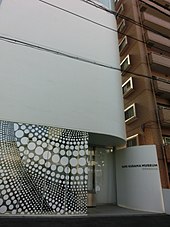
Besides in 2017, the Yayoi Kusama Museum opened in Tokyo, featuring her works.[51]
On nine November 2019, Kusama'due south Everyday I Pray For Love exhibit was shown at David Zwirner Gallery until fourteen December 2019. This exhibition incorporated sculptures and paintings. The exhibition was accompanied by a catalogue published by David Zwirner books containing texts and poems from the artist. This exhibition also included the debut of her INFINITY MIRRORED ROOM - DANCING LIGHTS THAT FLEW Upward TO THE UNIVERSE, 2019.[52]
In January 2020, the Hirshhorn announced it would debut new Kusama acquisitions, including two Infinity Mirror Rooms, at a forthcoming exhibition called One with Eternity: Yayoi Kusama in the Hirshhorn Drove.[53] The name of the exhibit is derived from an open letter of the alphabet Kusama wrote to then-President Richard Nixon in 1968, writing: "let'southward forget ourselves, dear Richard, and become ane with the absolute, all together in the altogether."[54]
In November 2021,[55] a monumental exhibition offering an overview of Kusama's chief artistic periods over the past 70 years, with some 200 works and four Infinity Rooms (unique mirror installations) debuted in the Tel Aviv Museum of Art. The retrospective spans near 3,000 yard2 across the Museum'south two buildings, in six galleries and includes two new works: A Bouquet of Love I Saw in the Universe, 2022 and Lite of the Universe Illuminating the Quest for Truth, 2021.
Meaning and origins of her piece of work [edit]
Curator Mika Yoshitake has stated that Kusama's works on display are meant to immerse the whole person into her accumulations, obsessions, and repetitions. These infinite, repetitive works were originally meant to eliminate Kusama's intrusive thoughts, but she at present shares information technology with the world.[56] Claire Voon has described one of Kusama's mirror exhibits as being able to "send y'all to quiet cosmos, to a lone labyrinth of pulsing light, or to what could exist the enveloping innards of a leviathan with the measles".[57]
Creating these feelings amongst audiences was intentional. These experiences seem to be unique to her work because Kusama wanted others to sympathize with her in her troubled life.[57] Bedatri D. Choudhury has described how Kusama's lack of feeling in control throughout her life made her, either consciously or subconsciously, want to control how others perceive time and infinite when entering her exhibits. This argument seems to imply that without her trauma, Kusama would not have created these works as well or perhaps not at all. Art had go a coping mechanism for Kusama.[58]
Works and publications [edit]

Functioning [edit]
In Yayoi Kusama'southward Walking Piece (1966), a performance that was documented in a serial of xviii colour slides, Kusama walked forth the streets of New York City in a traditional Japanese kimono while property a parasol. The kimono suggested traditional roles for women in Japanese custom. The parasol, however, was made to look inauthentic, as it was actually a black umbrella, painted white on the exterior and decorated with fake flowers. Kusama walked down unoccupied streets in an unknown quest. She and then turned and cried without reason, and somewhen walked abroad and vanished from view.
This performance, through the association of the kimono, involved the stereotypes that Asian-American women connected to face. Even so, as an avant-garde creative person living in New York, her situation altered the context of the wearing apparel, creating a cross-cultural amalgamation. Kusama was able to highlight the stereotype in which her white American audience categorized her, by showing the absurdity of culturally categorizing people in the world's largest melting pot.[59]
Motion-picture show [edit]
In 1968, Kusama and Jud Yalkut'south collaborative piece of work Kusama'southward Self-Obliteration won a prize at the Fourth International Experimental Motion picture Contest in Kingdom of belgium[60] and the Second Maryland Film Festival and the 2nd prize at the Ann Arbor Motion picture Festival. The 1967 experimental motion picture, which Kusama produced and starred in, depicted Kusama painting polka dots on everything around her including bodies.[60]
In 1991, Kusama starred in the film Tokyo Decadence, written and directed by Ryu Murakami, and in 1993, she collaborated with British musician Peter Gabriel on an installation in Yokohama.[19] [61]
Manner [edit]
In 1968, Kusama established Kusama Fashion Company Ltd, and began selling avantgarde fashion in the "Kusama Corner" at Bloomingdales.[62] In 2009, Kusama designed a handbag-shaped jail cell phone entitled Pocketbook for Space Travel, My Doggie Ring-Band, a pink dotted phone in accompanying dog-shaped holder, and a red and white dotted phone inside a mirrored, dotted box dubbed Dots Obsession, Full Happiness With Dots, for Japanese mobile communication giant KDDI Corporation'south "iida" brand.[63] Each telephone was limited to 1,000 pieces.
In 2011, Kusama created artwork for six limited-edition lipglosses from Lancôme.[64] That same yr, she worked with Marc Jacobs (who visited her studio in Japan in 2006) on a line of Louis Vuitton products,[65] including leather appurtenances, ready-to-wear, accessories, shoes, watches, and jewelry.[66] The products became available in 2012 at a SoHo pop-up store, which was busy with Kusama's trademark tentacle-like protrusions and polka-dots. Eventually, half-dozen other popular-up shops were opened effectually the world. When asked well-nigh her collaboration with Marc Jacobs, Kusama replied that "his sincere attitude toward art" is the same as her own.[67]
Writing [edit]
In 1977, Kusama published a book of poems and paintings entitled 7. One year afterward, her first novel Manhattan Suicide Addict appeared. Betwixt 1983 and 1990, she finished the novels The Hustler's Grotto of Christopher Street (1983), The Burning of St Mark'due south Church building (1985), Between Heaven and Globe (1988), Woodstock Phallus Cutter (1988), Aching Chandelier (1989), Double Suicide at Sakuragazuka (1989), and Angels in Cape Cod (1990), alongside several issues of the magazine S&One thousand Sniper in collaboration with photographer Nobuyoshi Araki.[19] Her most recent writing endeavor includes her autobiography Infinity Net [68] published in 2003 that depicts her life from growing upwards in Japan, her divergence to the Usa, and her render to her dwelling house country, where she now resides. Infinity Net also includes some of the artist's poetry and photos of her exhibitions.
Commissions [edit]

Red Pumpkin (2006), Naoshima
To engagement, Kusama has completed several major outdoor sculptural commissions, mostly in the course of brightly hued monstrous plants and flowers, for public and private institutions including Pumpkin (1994) for the Fukuoka Municipal Museum of Art; The Visionary Flowers (2002) for the Matsumoto City Museum of Art; Tsumari in Bloom (2003) for Matsudai Station, Niigata; Tulipes de Shangri-La (2003) for Euralille in Lille, France; Pumpkin (2006) at Bunka-mura on Benesse Island of Naoshima; Hullo, Anyang with Love (2007) for Pyeonghwa Park (now referred every bit World Cup Park), Anyang; and The Hymn of Life: Tulips (2007) for the Beverly Gardens Park in Los Angeles.[69] In 1998, she realized a mural for the hallway of the Gare do Oriente subway station in Lisbon. Aslope these monumental works, she has produced smaller scale outdoor pieces including Key-Chan and Ryu-Chan, a pair of dotted dogs. All the outdoor works are bandage in highly durable fiberglass-reinforced plastic, then painted in urethane to sleeky perfection.[lxx]
In 2010, Kusama designed a Town Sneaker styled jitney, which she titled Mizutama Ranbu (Wild Polka Dot Dance) and whose route travels through her hometown of Matsumoto.[nineteen] In 2011, she was commissioned to design the front cover of millions of pocket London Underground maps; the result is entitled Polka Dots Festival in London (2011). Congruent with an exhibition of the artist's work at the Whitney Museum of American Art in 2012, a 120-foot (37 m) reproduction of Kusama's painting Yellow Trees (1994) covered a condominium building under structure in New York's Meatpacking District.[71] That same twelvemonth, Kusama conceived her floor installation Thousands of Eyes as a commission for the new Queen Elizabeth II Courts of Law, Brisbane.[72]
Exhibition catalogs [edit]
- Rodenbeck, J.F. "Yayoi Kusama: Surface, Run up, Skin." Zegher, G. Catherine de. Within the Visible: An Elliptical Traverse of 20th Century Art in, of, and from the Feminine. Cambridge, Mass: The MIT Press, 1996. ISBN 978-0-262-54081-0 OCLC 33863951
- Plant of Gimmicky Fine art, Boston, 30 Jan – 12 May 1996.
- Kusama, Yayoi, and Damien Hirst. Yayoi Kusama Now. New York, N.Y.: Robert Miller Gallery, 1998. ISBN 978-0-944-68058-2 OCLC 42448762
- Robert Miller Gallery, New York, 11 June – vii August 1998.
- Kusama, Yayoi, and Lynn Zelevansky. Honey Forever: Yayoi Kusama, 1958–1968. Los Angeles: Los Angeles Canton Museum of Art, 1998. ISBN 978-0-875-87181-3 OCLC 39030076
- Los Angeles County Museum of Art, 8 March – 8 June 1998; three other locations through 4 July 1999.
- Kusama, Yayoi. Yayoi Kusama. Wien: Kunsthalle Wien, 2002. ISBN 978-three-852-47034-4 OCLC 602369060
- Kusama, Yayoi. Yayoi Kusama. Paris: Les Presses du Reel, 2002. ISBN 978-0-714-83920-2 OCLC 50628150
- Seven European exhibitions in France, Germany, Denmark, etc.; 2001–2003.
- Kusama, Yayoi. Kusamatorikkusu = Kusamatrix. Tōkyō: Kadokawa Shoten, 2004. ISBN 978-4-048-53741-4 OCLC 169879689
- Mori Art Museum, 7 February – 9 May 2004; Mori Geijutsu Bijutsukan, Sapporo, 5 June – 22 August 2004.
- Kusama, Yayoi, and Tōru Matsumoto. Kusama Yayoi eien no genzai = Yayoi Kusama: eternity-modernity. Tōkyō: Bijutsu Shuppansha, 2005. ISBN 978-four-568-10353-3 OCLC 63197423
- Tōkyō Kokuritsu Kindai Bijutsukan, 26 October – 19 December 2004; Kyōto Kokuritsu Kindai Bijutsukan, half dozen January – xiii February 2005; Hiroshima-shi Gendai Bijutsukan, 22 February – 17 April 2005; Kumamoto-shi Gendai Bijutsukan, 29 April – iii July 2005; at Matsumoto-shi Bijutsukan, 30 July – 10 October 2005.
- Applin, Jo, and Yayoi Kusama. Yayoi Kusama. London: Victoria Miro Gallery, 2007. ISBN 978-0-955-45644-2 OCLC 501970783
- Victoria Miro Gallery, London, 10 Oct – 17 November 2007.
- Kusama, Yayoi. Yayoi Kusama. New York: Gagosian Gallery, 2009. ISBN 978-one-932-59894-0 OCLC 320277816
- Gagosian Gallery, New York, 16 April – 27 June 2009; Gagosian Gallery, Beverly Hills, 30 May – 17 July 2009.
- Morris, Frances, and Jo Applin. Yayoi Kusama. London: Tate Publishing, 2012. ISBN 978-ane-854-37939-ix OCLC 781163109
- Reina Sofia, Madrid, ten May – 12 September 2011; Centre Pompidou, Paris, x October 2011 – 9 January 2012; Whitney Museum of American Art, New York, 12 July – xxx September 2012; Tate Modernistic (London), 9 February – 5 June 2012.
- Kusama, Yayoi, and Akira Tatehata. Yayoi Kusama: I Who Have Arrived in Sky. New York: David Zwirner, 2014. ISBN 978-0-989-98093-7 OCLC 879584489
- David Zwirner Gallery, New York, 8 November – 21 December 2013.
- Laurberg, Marie: Yayoi Kusama – In Infinity, Denmark: Louisiana Museum of Modernistic Art, 2015, Heine Onstadt, Oslo, 2016, Moderna Museum, Stockholm, 2016, and Helsinki Art Museum, 2016
- David Zwirner Gallery, New York, 9 November – fourteen December 2019.[73]
Illustration piece of work [edit]
- Carroll, Lewis and Yayoi Kusama. Lewis Carroll'southward Alice'southward Adventures in Wonderland. London: Penguin Classics, 2012. ISBN 978-0-141-19730-2 OCLC 54167867
Chapters [edit]
- Nakajima, Izumi. "Yayoi Kusama between brainchild and pathology." Pollock, Griselda. Psychoanalysis and the Image: Transdisciplinary Perspectives. Malden, MA: Blackwell Pub, 2006. pp. 127–160. ISBN 978-ane-405-13460-vi OCLC 62755557
- Klaus Podoll, "Die Künstlerin Yayoi Kusama als pathographischer Autumn." Schulz R, Bonanni G, Bormuth M, eds. Wahrheit ist, was uns verbindet: Karl Jaspers' Kunst zu philosophieren. Göttingen, Wallstein, 2009. p. 119. ISBN 978-iii-835-30423-nine OCLC 429664716
- Cutler, Jody B. "Narcissus, Narcosis, Neurosis: The Visions of Yayoi Kusama." Wallace, Isabelle Loring, and Jennie Hirsh. Gimmicky Art and Classical Myth. Farnham, Surrey: Ashgate, 2011. pp. 87–109. ISBN 978-0-754-66974-6 OCLC 640515432
Autobiography, writing [edit]
- Kusama, Yayoi. A Book of Poems and Paintings. Tokyo: Japan Edition Art, 1977.
- Kusama, Yayoi. Kusama Yayoi: Driving Image = Yayoi Kusama. Tōkyō: PARCO shuppan, 1986. ISBN 978-iv-891-94130-7 OCLC 54943729
- Kusama, Yayoi, Ralph F. McCarthy, Hisako Ifshin, and Yayoi Kusama. Violet Obsession: Poems. Berkeley: Wandering Heed Books, 1998. ISBN 978-0-965-33043-5 OCLC 82910478
- Kusama, Yayoi, Ralph F. McCarthy, Yayoi Kusama, and Yayoi Kusama. Hustlers Grotto: 3 Novellas. Berkeley, Calif: Wandering Heed Books, 1998. ISBN 978-0-965-33042-viii OCLC 45665616
- Kusama, Yayoi. Infinity Net: The Autobiography of Yayoi Kusama. Chicago: The University of Chicago Press, 2011. ISBN 978-0-226-46498-v OCLC 711050927
- Kusama, Yayoï, and Isabelle Charrier. Manhattan Suicide Addict. Dijon: Presses du Réel, 2005. ISBN 978-ii-840-66115-3 OCLC 420073474
Catalogue raisonné, etc. [edit]
- Kusama, Yayoi. Yayoi Kusama: Impress Works. Tokyo: Abe Corp, 1992. ISBN 978-four-872-42023-iv OCLC 45198668
- Hoptman, Laura, Akira Tatehata, and Udo Kultermann. Yayoi Kusama. London: Phaidon Printing, 2003. ISBN 978-0-714-83920-2 OCLC 749417124
- Kusama, Yayoi, and Hideki Yasuda. Yayoi Kusama Furniture by Graf: Decorative Mode No. 3. Tōkyō: Seigensha Art Publishing, 2003. ISBN 978-4-916-09470-4 OCLC 71424904
- Kusama, Yayoi. Kusama Yayoi zen hangashū, 1979–2004 = All Prints of Kusama Yayoi, 1979–2004. Tōkyō: Abe Shuppan, 2006. ISBN 978-4-872-42174-three OCLC 173274568
- Kusama, Yayoi, Laura Hoptman, Akira Tatehata, Udo Kultermann, Catherine Taft. Yayoi Kusama. London: Phaidon Press, 2017. ISBN 978-0-714-87345-9 OCLC 749417124
- Yoshitake, Mika, Chiu, Melissa, Dumbadze, Alexander Blair, Jones, Alex, Sutton, Gloria, Tezuka, Miwako. Yayoi Kusama : Infinity Mirrors. Washington, DC. ISBN 978-iii-7913-5594-viii. OCLC 954134388
Exhibitions [edit]
In 1959, Kusama had her first solo exhibition in New York at the Brata Gallery, an artist's co-op. She showed a series of white internet paintings which were enthusiastically reviewed past Donald Judd (both Judd and Frank Stella then caused paintings from the show).[21] Kusama has since exhibited work with Claes Oldenburg, Andy Warhol, and Jasper Johns, amongst others. Exhibiting alongside European artists including Lucio Fontana, Pol Bury, Otto Piene, and Gunther Uecker, in 1962 she was the simply female artist to take part in the widely acclaimed Nul (Zippo) international group exhibition at the Stedelijk Museum in Amsterdam.[74]
Exhibition list [edit]

Yayoi Kusama's retrospective exhibition at Tate Modern, London, in early 2012
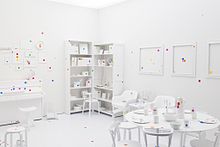
Yayoi Kusama's Obliteration Room (2015) was inspired past the earlier Infinity Mirror Room
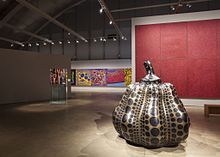
An exhibition for the HAM art company (October 2016)
- 1976: Kitakyushu Municipal Museum of Art
- 1983: Yayoi Kusama's Self-Obliteration (Performance) at Video Gallery Scan, Tokyo, Japan
- 1987: Fukuoka, Japan
- 1989: Eye for International Contemporary Arts, New York
- 1993: Represented Japan at the Venice Biennale
- 1996: Contempo Works at Robert Miller Gallery
- 1998–1999: Retrospective exhibition of work toured the The states and Japan
- 1998: "Love Forever: Yayoi Kusama,1958–1969", LACMA
- 1998–99: "Honey Forever: Yayoi Kusama,1958–1969" – exhibit traveled to Museum of Modern Art, New York, Walker Art Centre, Minneapolis and Museum of Contemporary Fine art, Tokyo)
- 2000: Le Consortium, Dijon
- 2001–2003: Le Consortium – exhibit traveled to Maison de la Culture du Japon, Paris; Kunsthallen Brandts, Odense, Denmark; Les Abattoirs, Toulouse; Kunsthalle Wien, Vienna; and Artsonje Centre, Seoul
- 2004: KUSAMATRIX, Mori Fine art Museum, Tokyo
- 2004–2005: KUSAMATRIX traveled to Fine art Park Museum of Contemporary Art, Sapporo Art Park, Hokkaido); Eternity – Modernity, National Museum of Modern Art, Tokyo (touring Nihon)
- 2007: FINA Festival 2007. Kusama created Guidepost to the New Space, a vibrant outdoor installation for Birrarung Marr beside the Yarra River in Melbourne. In 2009, the Guideposts were re-installed at Fairchild Tropical Botanic Garden, this fourth dimension displayed as floating "humps" on a lake.[75]
- 2008: The Mirrored Years, Museum Boijmans Van Beuningen, Rotterdam, the netherlands
- 2009: The Mirrored Years traveled to Museum of Gimmicky Art, Sydney, and City Gallery, Wellington, New Zealand
- August 2010: Aichi Triennale 2010, Nagoya. Works were exhibited within the Aichi Arts Center, out of the center and Toyota machine polka dot projection.
- 2010: Museum Boijmans Van Beuningen purchased the work Infinity Mirror Room – Phalli's Field. As of 13 September of that year the mirror room is permanently exhibited in the entrance surface area of the museum.
- July 2011: Museo Reina Sofía, Madrid, Spain
- 2012: Tate Modern, London.[76] Described equally "akin to being suspended in a beautiful cosmos gazing at space worlds, or similar a tiny dot of fluoresecent plankton in an bounding main of glowing microscopic life",[77] the exhibition features a retrospective spanning Kusama's entire career.
- 15 July 2013 – 3 November 2013: Daegu Art Museum, Daegu, Korea
- 30 June 2013 – xvi September 2013: MALBA, the Latinamerican Art Museum of Buenos Aires, Buenos Aires, Argentina
- 22 May 2022 – 27 June 2014: Instituto Tomie Ohtake, São Paulo, Brazil
- 17 September 2022 – 24 January 2016: In Infinity, Louisiana Museum of Modern Art, Humlebæk, Denmark[78]
- 12 June – 9 Baronial 2015: Yayoi Kusama: Infinity Theory, The Garage Museum of Contemporary Art, Moscow, Russian federation. This was the creative person'south offset solo exhibition in Russia.[79]
- 19 February – fifteen May 2016: Yayoi Kusama – I uendeligheten, Henie Onstad Kunstsenter, Oslo, Norway
- 20 September 2022 – September 2016: Yayoi Kusama: Infinity Mirrored Room, The Broad, Los Angeles, California
- 12 June – 18 September 2016: Kusama: At the End of the Universe, Museum of Fine Arts, Houston, Houston, Texas
- ane May 2022 – 30 November 2016: Yayoi Kusama: Narcissus Garden, The Glass House, New Canaan, Connecticut.
- 25 May 2022 – 30 July 2016: Yayoi Kusama: sculptures, paintings & mirror rooms, Victoria Miro Gallery, London, Uk.
- 7 October 2022 – 22 January 2017: Yayoi Kusama: In Infinity, organised by the Louisiana Museum of Modern Art in cooperation with Henie Onstad Kunstsenter, Moderna Museet/ArkDes and Helsinki Art Museum HAM in Helsinki, Finland.[lxxx]
- five November 2022 – 17 April 2017: "Dot Obsessions – Tasmania", MONA: Museum of Old and New Art, Hobart, Australia.[81]
- 23 February 2022 – fourteen May 2017: Yayoi Kusama: Infinity Mirrors, a traveling museum show originating at the Hirshhorn Museum and Sculpture Garden, Washington, DC[82] [47]
- thirty June 2022 – 10 September 2017: Yayoi Kusama: Infinity Mirrors, exhibition travels to Seattle Art Museum, Seattle, Washington
- nine June 2022 – 3 September 2017: Yayoi Kusama: Life is the Centre of a Rainbow, National Gallery Singapore.[83]
- October 2022 – Jan 2018: Yayoi Kusama: Infinity Mirrors, exhibition travels to The Broad, Los Angeles, California
- Oct 2022 – February 2018: Yayoi Kusama: All the Eternal Dear I Have for the Pumpkins, Dallas Museum of Art, Dallas, Texas
- November 2022 – February 2018: Yayoi Kusama: Life is the Heart of a Rainbow and Obliteration Room, GOMA, Brisbane, Australia[84]
- Dec 2022 – April 2018: Blossom Obsession, Triennial, NGV, Melbourne, Australia
- March 2022 – February 2019"Pumpkin Forever'(Forever Museum of ContemporaryArt), Gion-Kyoto, Nippon
- March–May 2018: Yayoi Kusama: Infinity Mirrors, exhibition travels to Art Gallery of Ontario, Toronto, Ontario, Canada
- March–July 2018: Yayoi Kusama: All Well-nigh My Honey, Matsumoto Metropolis Museum of Art, Matsumoto, Nagano, Nihon
- May–September 2018: Yayoi Kusama: Life is the Center of a Rainbow, Museum of Mod and Contemporary Fine art in Nusantara (Museum MACAN), Jakarta, Indonesia[85]
- July–September 2018: Yayoi Kusama: Infinity Mirrors, exhibition travels to Cleveland Museum of Art, exhibition travels to Cleveland, Ohio
- July–November 2018: Yayoi Kusama: Where The Lights In My Heart Go, exhibition travels to deCordova Museum and Sculpture Park, Lincoln, MA
- 26 July 2022 - Spring 2019: Yayoi Kusama: With All My Love for the Tulips, I Pray Forever [86] (2011)
- March–September 2019: Yayoi Kusama, Museum Voorlinden, Wassenaar, The Netherlands
- ix Nov 2022 – xiv December 2019: Yayoi Kusama: Everyday I Pray For Love, David Zwirner Gallery, New York, NY[73]
- 4 January – 18 March 2020: Brilliance of the Souls, Maraya, AlUla
- four April – xix September 2020: Yayoi Kusama: "One with Eternity: Yayoi Kusama in the Hirshhorn Drove," Washington, DC[53]
- 31 July 2022 – 3 January 2021: STARS: Six Gimmicky Artists from Japan to the World, Tokyo, Nihon[87]
- ten April 2022 – 31 Oct 21: Kusama: Cosmic Nature, New York Botanical Garden, New York, NY[88] [89]
- fifteen November 2022 - 23 Apr 2022: "Yayoi Kusama : A Retrospective", Tel Aviv Museum of Fine art, Israel [90] [91]
Permanent Infinity Room installations [edit]
- Infinity Dots Mirrored Room (1996), Mattress Factory, Pittsburgh, Pennsylvania
- Infinity Mirror Room fireflies on H2o (2000), Musée des Beaux-Arts de Nancy, Nancy (French republic)
- You lot Who Are Getting Obliterated in the Dancing Swarm of Fireflies (2005), Phoenix Fine art Museum, Phoenix, Arizona[92]
- Gleaming Lights of the Souls (2008), Louisiana Museum of Modern Fine art, Humlebæk, Denmark[93]
- The Souls of Millions of Light Years Away (2013), The Broad, Los Angeles, California[47]
- The Spirits of the Pumpkins Descended into the Heavens (2015), National Gallery of Commonwealth of australia, Canberra[94]
- Phalli'due south Field (1965/2016), Museum Boijmans Van Beuningen, Rotterdam, Netherlands
- Dearest is Calling (2013/2019), Institute of Contemporary Art, Boston, Boston, Massachusetts[95]
- Light of Life (2018), North Carolina Museum of Fine art, Raleigh, North Carolina
- Brilliance of the Souls (2019), Museum of Modern and Contemporary Art in Nusantara (Museum MACAN), Jakarta, Indonesia[96]
- Infinity Mirror Room – Let'due south Survive Forever (2019), Fine art Gallery of Ontario, Toronto, Ontario[97]
Peer review [edit]
- Applin, Jo. Yayoi Kusama: Infinity Mirror Room – Phallis Field. Afterall, 2012.
- Hoptman, Laura J., et al. Yayoi Kusama. Phaidon Printing Express, 2000.
- Lenz, Heather, manager. Infinity. Magnolia Pictures, 2018.
Collections [edit]
Kusama's work is in the collections of museums throughout the world, including the Museum of Modern Art, New York; Los Angeles County Museum of Art, Los Angeles; Walker Art Center, Minneapolis; Phoenix Art Museum, Phoenix; Tate Modern, London; Stedelijk Museum, Amsterdam; Centre Pompidou, Paris; Utah Museum of Fine Arts, Salt Lake City, UT; and the National Museum of Modernistic Art, Tokyo.
Recognition [edit]
Yayoi Kusama's image is included in the iconic 1972 affiche Some Living American Women Artists by Mary Beth Edelson.[98]
In 2017, a fifty-year retrospective of Kusama'south work opened at the Hirshhorn Museum in Washington, DC. That same year, the Yayoi Kusama Museum was inaugurated in Tokyo. Other major retrospectives of her work take been held at the Museum of Modern Art (1998), the Whitney Museum (2012), and the Tate Modern (2012).[99] [100] [101] In 2015, the website Artsy named Kusama 1 of its top 10 living artists of the twelvemonth.[102]
Kusama has received many awards, including the Asahi Prize (2001); Ordre des Arts et des Lettres (2003); the National Lifetime Achievement Honor from the Society of the Rise Sun (2006); and a Lifetime Achievement Accolade from the Women's Caucus for Art.[103] In October 2006, Kusama became the first Japanese woman to receive the Praemium Imperiale, one of Japan's highest honors for internationally recognized artists.[104] She also received the Person of Cultural Merit (2009) and Ango awards (2014).[105] In 2014, Kusama was ranked the well-nigh popular artist of the year after a tape-breaking number of visitors flooded her Latin American tour, Yayoi Kusama: Infinite Obsession. Venues from Buenos Aires to Mexico City received more than 8,500 visitors each day.[106]
The octogenarian also gained media attending for partnering with the Hirshhorn Museum and Sculpture Garden to brand her 2017 Infinity Mirror rooms accessible to visitors with disabilities or mobility problems; in a new initiative amongst art museums, the venue mapped out the 6 private rooms and provided disabled individuals visiting the exhibition access to a complete 360-degree virtual reality headset that allowed them to experience every aspect of the rooms,[107] as if they were really walking through them.[108]
Art marketplace [edit]
Kusama's work has performed strongly at auction: meridian prices for her work are for paintings from the late 1950s and early 1960s. As of 2012, her work has the highest turnover of any living woman creative person.[109] In November 2008, Christie's New York sold a 1959 white Infinity Cyberspace painting formerly owned by Donald Judd,[19] No. 2, for U.s.a.$5.one million, then a record for a living female person artist.[110] In comparison, the highest price for a sculpture from her New York years is £72,500 (US$147,687), fetched by the 1965 wool, pasta, paint and hanger assemblage Golden Macaroni Jacket at Sotheby'south London in Oct 2007. A 2006 acrylic on fiberglass-reinforced plastic pumpkin earned $264,000, the top toll for one of her sculptures, also at Sotheby's in 2007[111] Her Flame of Life – Dedicated to Tu-Fu (Du-Fu) sold for United states of america$960,000 at Art Basel/Hong Kong in May 2013, the highest price paid at the show. Kusama became the nigh expensive living female creative person at auction when White No. 28 (1960) from her signature Infinity Nets series sold for $vii.i million at a 2022 Christie's auction.[112]
In popular civilisation [edit]

Anti-graffiti art inspired by Kusama's polka dot motif serves every bit (from a distance) camouflage in Idaho (2015)
- Superchunk, an American indie band, included a song chosen "Fine art Class (Song for Yayoi Kusama)" on its Here'due south to Shutting Up album.[113]
- In 1967, Jud Yalkut made a film of Kusama titled Kusama'southward Self-Obliteration. [114]
- Yoko Ono cites Kusama every bit an influence.[115] [116]
- The 2004 Matsumoto Performing Art Heart in Kusama's hometown Matsumoto, designed by Toyo Ito, has an entirely dotted façade.[117]
- She is mentioned in the lyrics of the Le Tigre vocal "Hot Topic".[118]
- In 2013, the British indie pop duo The Boy To the lowest degree Likely To made song tribute to Yayoi Kusama, writing a vocal specially about her.[119] They wrote on their blog that they admire Kusama's work considering she puts her fears into it, something that they themselves oft do.[120]
- The Nels Cline Singers dedicated i runway, "Macroscopic (for Kusama-san)" of their 2022 anthology, Macroscope to Kusama.[121]
- Magnolia Pictures released the biographical documentary Kusama: Infinity on vii September 2018[122] and a DVD version on eight January 2019.[123]
- Veuve Clicquot and Kusama created a limited-edition canteen and sculpture in September 2020.[124]
References [edit]
- ^ a b c Yamamura, Midori (2015), Yayoi Kusama: Inventing the Atypical. MIT Press. ISBN 9780262029476.
- ^ "Yayoi Kusama". guggenheim.org . Retrieved 21 February 2018.
- ^ Griselda, Pollock (2006). Psychoanalysis and the image : transdisciplinary perspectives. Malden, MA: Blackwell Publishers. ISBN978-1405134613. OCLC 62755557.
- ^ "Yayoi Kusama, Harry Shunk, János Kender. The Anatomic Explosion, New York. 1968 | MoMA". The Museum of Modern Art . Retrieved 21 February 2018.
- ^ "Yayoi Kusama, Harry Shunk, János Kender. Mirror Performance, New York. 1968 | MoMA". The Museum of Modernistic Art . Retrieved 21 Feb 2018.
- ^ Taylor, Kate (28 Feb 2018). "How Yayoi Kusama'due south Infinity Mirrors pushed pop fine art into the new age". Retrieved four March 2018.
- ^ a b "Yayoi Kusama Biography, Life & Quotes". The Fine art Story . Retrieved 29 February 2020.
- ^ Swanson, Carl (6 July 2012). "The Fine art of the Flame-Out". New York.
- ^ "Yayoi Kusama | Biography, Art, & Facts". Encyclopædia Britannica . Retrieved 1 September 2019.
- ^ a b Farah Nayeri (14 February 2012), Man-Hating Artist Kusama Covers Tate Modern in Dots: Interview Bloomberg.
- ^ a b c d Pound, Cath. "Yayoi Kusama'south extraordinary survival story". BBC. Retrieved 7 May 2019.
- ^ a b Butler, Cornelia (2007). WACK! Art and the Feminist Revolution. MIT Printing. p. 257.
- ^ a b "The world according to Yayoi Kusama". Financial Times. 20 January 2012. Retrieved 11 March 2017.
- ^ Dailey, Megan. "YAYOI KUSAMA: ART Every bit AN ESCAPE".
- ^ a b Frank, Priscilla (9 February 2017). "Japanese Creative person Yayoi Kusama Is Well-nigh To Make 2022 Infinitely Better". HuffPost . Retrieved 11 March 2017.
- ^ a b c d Holland Cotter (12 July 2012), Vivid Hallucinations From a Fragile Life – Yayoi Kusama at Whitney Museum of American Art The New York Times.
- ^ Ignoramous, Lamos (26 May 2014). "Yayoi Kusama Self-Obliteration Assay | The Dissolve of Identity". Retrieved 11 March 2017.
- ^ a b Furman, Anna (six February 2017). "Yayoi Kusama Made the Ultimate Instagram Exhibit". The Cutting . Retrieved xi March 2017.
- ^ a b c d due east f 1000 Yayoi Kusama Timeline Queensland Art Gallery, Brisbane.
- ^ Taylor, Rachel (6 March 2012). "Yayoi Kusama'south early on years". Tate Etc.
- ^ a b Yayoi howdy , 18 November 1998 – 8 January 1999 Victoria Miro Gallery, London.
- ^ a b c David Pilling (20 January 2012), The earth according to Yayoi Kusama Financial Times Weekend Mag.
- ^ Bayly, Zac (2012), "Yayoi Kusama", Zac-Set on (interview), retrieved 21 September 2013
- ^ "Yayoi Kusama | Biography, Art, & Facts". Encyclopedia Britannica . Retrieved two October 2020.
- ^ Zoë Dusanne: An Art Dealer Who Made a Deviation, p99, by Jo Ann Ridley; Fithian Press, 2011
- ^ Liu, Belin (26 February 2009), "Yayoi Kusama", Bitch magazine, archived from the original on 23 June 2011, retrieved 30 November 2010
- ^ Midori Yoshimoto, Into Functioning: Japanese Women Artists in New York (New Brunswick: Rutgers University Printing, 2005) p.68
- ^ "Yayoi Kusama Art – 100+ Works, Bio, News | Artsy". www.cocked.net . Retrieved 17 July 2016.
- ^ a b Yayoi Kusama MoMA Collection, New York.
- ^ Kusama, Yayoi (1978), Manhattan jisatsu misui joshuhan [Manhattan Suicide Addict], Tokyo: Kosakusha , (extract) reproduced in Hoptman, Yayoi Kusama, et al., p. 124
- ^ Yayoi Kusama: Soul under the moon (2002) Queensland Art Gallery, Queensland.
- ^ Midori, Yoshimoto (2005). Into performance: Japanese women artists in New York. Rutgers Academy Printing. pp. 75–76. ISBN978-0813541051. OCLC 133159483.
- ^ Carl Swanson (8 July 2012), The Fine art of the Flame-Out New York.
- ^ Sullivan, Marin R. (2015). "Reflective Acts and Mirrored Images: Yayoi Kusama'due south Narcissus Garden". History of Photography. 39 (iv): 405–423. doi:10.1080/03087298.2015.1093775. S2CID 194226783.
- ^ a b "Kusama'due south relationship with Joseph Cornell". Tate Etc . Retrieved 23 May 2019.
- ^ Chappo, Ashley (vi April 2015). "The Stunning Story of the Adult female Who Is the World'due south Most Popular Artist". Observer . Retrieved 6 March 2017.
- ^ McDonald, John (12 Feb 2005), "Points of no render", The Sydney Morning time Herald , retrieved 30 November 2010
- ^ Art Review (interview), 2007, archived from the original on 20 September 2016, retrieved xviii Feb 2010
- ^ Yayoi Kusama (collection), New York: MoMA
- ^ Archive, Asia Art. "Yayoi Kusama: A Retrospective". aaa.org.hk . Retrieved 28 Apr 2020.
- ^ Gomez, By Edward M. (5 July 1998). "ART; A lx'south Free Spirit Whose Principal Subject area Was Herself". The New York Times. ISSN 0362-4331. Retrieved 28 April 2020.
- ^ Yayoi Kusama, New York/Los Angeles: Gagosian Gallery, 16 April – 27 June 2009, archived from the original on five Nov 2011
- ^ Yayoi Kusama, London: Victoria Miro Gallery, 7 February – 20 March 2008, archived from the original on 19 January 2012
- ^ Yayoi Kusama: Flowers That Bloom Tomorrow, 7 October – 13 November 2010 Victoria Miro Gallery, London.
- ^ Taylor, Rachel (2012). Yayoi Kusama: Contempo Work 2009–2012. London: Tate. ISBN9781-85437-939-9.
- ^ Dingfelder, Sadie (21 February 2017). "This exhibit is going to accident up your Instagram feed – and rewrite art history".
- ^ a b c "The Broad to Host Yayoi Kusama: Infinity Mirrors Exhibition in Autumn 2017" (PDF). The Broad: News. 16 August 2016. Retrieved 17 April 2017.
- ^ Hauser, Christine (28 February 2017). "Kusama Infinity Room Reopens at Hirshhorn Exhibition Afterwards Sculpture Impairment". The New York Times. ISSN 0362-4331. Retrieved 11 March 2017.
- ^ "Hirshhorn's 'Yayoi Kusama: Infinity Mirrors' Breaks Records". Smithsonian Institution. fifteen May 2017. Retrieved 9 March 2020.
- ^ "A Night With Yayoi Kusama's Die-hard, Selfie-taking Fans". Hyperallergic. 12 Nov 2019. Retrieved 29 Feb 2020.
- ^ "Yayoi Kusama Museum opens, sells out". The Nihon News. Archived from the original on 19 Oct 2017. Retrieved 18 Oct 2017.
- ^ "EVERY Solar day I PRAY FOR LOVE printing release". David Zwirner . Retrieved 18 December 2019.
- ^ a b "Hirshhorn Acquires 3 Major Works by Yayoi Kusama, Announces 2022 Legacy Exhibition". Smithsonian Establishment. 6 January 2020. Retrieved ix March 2020.
- ^ Daher, Nadine (14 January 2020). "Jubilant the Eternal Legacy of Artist Yayoi Kusama". Smithsonian Magazine . Retrieved 9 March 2020.
- ^ https://www.tamuseum.org.il/en/exhibition/yayoi-kusama-a-retrospective/
- ^ Fifield, Anna (15 February 2017). "How Yayoi Kusama, the "Infinity Mirrors" visionary, channels mental illness into fine art". The Washington Post . Retrieved vii May 2019.
- ^ a b Voon, Claire (23 February 2017). "Immersed in Yayoi Kusama's Lonely Labyrinths and Infinite Worlds". Hyperallergic . Retrieved 7 May 2019.
- ^ Choudhury, Bedatri D. (11 September 2018). "To Infinity and Beyond, Yayoi Kusama Grapples With Conventions". Hyperallergic . Retrieved 7 May 2019.
- ^ Schultz, Stacy E. (2012). "Asian American Women Artists: Performative Strategies Redefined". Journal of Asian American Studies. 15 (1): 105–27. doi:10.1353/jaas.2012.0000. S2CID 145241859.
- ^ a b Foster, Gwendolyn Audrey (18 Oct 2013). "Yayoi Kusama: The Orgy of Self Obliteration". Picture show International.
- ^ Ridey, Roger (23 October 2011). "All most Eve". The Independent.
- ^ Midori Matsui, Interview: Yayoi Kusama, 1998 Index Magazine.
- ^ Art Editions: Yayoi Kusama KDDI Corporation.
- ^ Emili Vesilind (24 May 2011), Lancôme collaborates with Japanese creative person Yayoi Kusama on new Juicy Tubes Los Angeles Times.
- ^ "Vuitton And Kusama". British Vogue . Retrieved 11 March 2017.
- ^ Binlot, Ann (nine January 2012), Marc Jacobs Recruits Yayoi Kusama for Latest Louis Vuitton Collaboration BLOUINARTINFO.
- ^ Swanson, Carl (9 July 2012). "Exclusive: Yayoi Kusama Talks Louis Vuitton, Plus a First Look at the Collection". The Cut . Retrieved 11 March 2017.
- ^ Kusama, Yayoi (2003). Infinity Net. Tate.
- ^ Kusama, sixteen April – 27 June 2009 [ expressionless link ] Gagosian Gallery, New York/Los Angeles.
- ^ Yayoi Kusama: Outdoor Sculptures, 23 June – 25 July 2009 Victoria Miro Gallery, London.
- ^ Laura Kusisto (2 August 2012), 'Xanthous Trees' Growing The Wall Street Journal.
- ^ Des Houghton (8 June 2012), Justice Minister Jarrod Bleijie condemns Yayoi Kusama artwork at new Supreme Courtroom and District Courtroom building in Brisbane The Courier-Mail service.
- ^ a b York, 537 Westward 20th Street New. "EVERY DAY I PRAY FOR Love". David Zwirner . Retrieved eighteen December 2019.
- ^ Yayoi Kusama: Mirrored Years, 23 August – 19 October 2008 Archived 25 May 2012 at the Wayback Machine Museum Boijmans Van Beuningen, Rotterdam.
- ^ "Yayoi Kusama at Fairchild", 5 December 2009 – 30 May 2010 Archived 17 December 2013 at the Wayback Machine Fairchild Tropical Botanic Garden.
- ^ "Yayoi Kusama". What'due south On. Tate Modern. Retrieved three June 2012.
- ^ Trebuchet Magazine http://world wide web.trebuchet-magazine.com/index.php/site/article/tate_modern_yayoi_kusama/
- ^ Rogers, Sam (25 September 2015). "In infinity: Yayoi Kusama's dots take over the Louisiana Museum of Modern Fine art". Wallpaper . Retrieved 16 December 2015.
- ^ "Yayoi Kusama: Infinity Theory [exhibition website]". Garage Museum of Contemporary Art. 2015. Retrieved 16 December 2015.
- ^ "Yayoi Kusama: In Infinity". Retrieved half-dozen April 2017.
- ^ "Yayoi Kusama'south new installation comes to MONA Tasmania". 22 October 2016. Retrieved 17 June 2017.
- ^ Finkel, Jori (sixteen August 2016). "Yayoi Kusama to Exist the Focus of a Touring Museum Evidence". The New York Times. ISSN 0362-4331. Retrieved eleven March 2017.
- ^ "Yayoi Kusama heads to Singapore, while Southeast Asian fine art travels the globe". 2016.
- ^ "Yayoi Kusama".
- ^ "Yayoi Kusama'south works finally get in in Djakarta". The Jakarta Mail . Retrieved 9 May 2018.
- ^ Stuart, Gwynedd (25 July 2018). "Another Yayoi Kusama Installation Has Arrived in L.A.—and You lot Tin See Information technology For Free". Los Angeles Magazine . Retrieved five Nov 2021.
- ^ "STARS: Six Gimmicky Artists from Nihon to the World". www.mori.art.museum . Retrieved 18 August 2020.
- ^ Heinrich, Will (ix April 2021). "Yayoi Kusama's 'Cosmic Nature' Dots a Bronx Garden". The New York Times.
- ^ Yoshitake, Mika, ed. (2021). Yayoi Kusama: Cosmic Nature. New York: Rizzoli Electa. ISBN978-0-8478-6839-ane.
- ^ "Yayoi Kusama: A Retrospective \ Tel Aviv Museum of Art".
- ^ "This Tel Aviv Museum Show Simply Opened. Information technology's Already Sold Out". Haaretz.
- ^ "Yayoi Kusama Infinity Mirror Room, Phoenix Art Museum, Firefly Room". Retrieved 22 October 2017.
- ^ "Kusama Installation". Louisiana Museum of Modern Art. Archived from the original on 19 August 2018. Retrieved ix Oct 2017.
- ^ "Yayoi Kusama: The Spirits of the Pumpkins Descended into the Heavens". NGA . Retrieved 6 May 2019.
- ^ Selvin, Claire (xv January 2019). "ICA Boston Acquires Yayoi Kusama 'Infinity Mirror Room' Piece of work". ARTnews . Retrieved 23 May 2019.
- ^ "Yayoi Kusama'south 'Infinity Room' to return permanently to Museum MACAN". The Jakarta Post . Retrieved 30 August 2019.
- ^ Mudhar, Raju (4 April 2019). "Set up for your selfie ? AGO's permanent Kusama Infinity Mirrored Room now open". The Toronto Star. Torstar Corporation. Retrieved 9 May 2020.
- ^ "Some Living American Women Artists/Final Supper". Smithsonian American Fine art Museum . Retrieved 21 January 2022.
- ^ Love Forever : Yayoi Kusama, 1958–1968, 9 July – 22 September 1998, The Museum of Modern Art, New York.
- ^ YAYOI KUSAMA, 12 July – Sept xxx, 2012, Whitney Museum of American Art, New York.
- ^ Yayoi Kusama, 9 February – 5 June 2012, Tate Modern, London.
- ^ "The Top 10 Living Artists of 2015". Artsy. 16 December 2015. Retrieved 16 December 2015.
- ^ "WCA By Honorees".
- ^ Blouinartinfo (23 January 2007). "Fine art News: Kusama Offset Japanese Adult female to Win Coveted Fine art Honor". BLOUINARTINFO. Retrieved 23 April 2008.
- ^ "安吾賞-第9回 受賞者". Ango awards . Retrieved 8 March 2015.
- ^ Pes, Javier; Emily Sharpe (2 April 2015). "Visitor Figures 2014: The Earth Goes Dotty Over Yayoi Kusama". The Art Newspaper. Archived from the original on 12 March 2017.
- ^ Lesser, Casey (17 February 2017). "Yayoi Kusama'south Infinity Rooms Made Attainable to People with Disabilities for Showtime Time". Artsy . Retrieved 11 March 2017.
- ^ Overly, Steven (ix March 2017). "People in wheelchairs couldn't see Yayoi Kusama's 'Infinity Mirrors'. The museum plant an innovative set". The Washington Post . Retrieved 11 March 2017.
- ^ Sarah Thornton (20 May 2012), The price of being female The Economist.
- ^ Cross-Cultural Journeys: Yayoi Kusama and Kenzo Okada Christie's.
- ^ Bridget Moriarity (5 March 2009), Artist Dossier: Yayoi Kusama Art+Auction.
- ^ Kelly Crow (12 November 2014), Christie's Makes History With $853 Million Sale of Contemporary Fine art – Andy Warhol'due south 'Triple Elvis [Ferus Blazon]' Sells for $82 Million The Wall Street Journal.
- ^ Superchunk - Art Class (Song For Yayoi Kusama) , retrieved xiv March 2022
- ^ Zinman, Gregory (September 2013). "DREAM REELER: Jud Yalkut (1938–2013)". The Brooklyn Rail.
- ^ Patel, Nisha (23 November 2016). "The Self-Obliteration Of Yayoi Kusama". Civilisation Trip . Retrieved 13 September 2020.
- ^ "Polka dots from another globe". EL PAÍS. thirteen May 2011. Retrieved xiii September 2020.
- ^ open buildings.com. Retrieved 30 Jan 2015.
- ^ Oler, Tammy (31 October 2019). "57 Champions of Queer Feminism, All Name-Dropped in One Impossibly Tricky Song". Slate Magazine.
- ^ "a world of polka dots, past the male child least probable to". the boy to the lowest degree probable to . Retrieved 23 May 2019.
- ^ blog spirit.com Archived 23 Baronial 2013 at the Wayback Car
- ^ "VIA CHICAGO: Q&A w/ Wilco Guitarist Nels Cline". 30 April 2014. Retrieved 23 May 2019.
- ^ "Kusama: Infinity". IMDb. 11 May 2018. Retrieved 23 May 2019.
- ^ "Kusama: Infinity DVD". Retrieved 23 May 2019 – via blu-ray.com.
- ^ "Yayoi Kusama'south Famous Polka Dots Beautify Veuve Clicquot Champagne Collaboration". HYPEBEAST. nine September 2020. Retrieved 27 November 2020.
- Smith, Roberta. "Yayoi Kusama and the Astonishing Polka dotted selfie fabricated journey to greatness". The New York Times . Retrieved 4 April 2018.
External links [edit]
- Official Site
- YAYOI KUSAMA MUSEUM (English)
- Love Forever: Yayoi Kusama, 1958–1968, Museum of Mod Fine art
- How to Paint Like Yayoi Kusama
- Yayoi Kusama in the collection of The Museum of Modernistic Art
- [*Women Artists and Postwar Abstraction | HOW TO Run across the art move with Corey D'Augustine, MoMA
- Phoenix Art Museum online Archived 28 Jan 2022 at the Wayback Machine
- World is a polka dot. An interview with Yayoi Kusama Video by Louisiana Channel
- BBC NewsNight Yayoi Kusama
- Why Yayoi Kusama matters now more than always
- Yayoi Kusama fine art for the Instagram age
- Yayoi Kusama/artnet
Source: https://en.wikipedia.org/wiki/Yayoi_Kusama
0 Response to "Primal Water an Exhibition of Japanese Contemporary Art 7 De Julho"
Postar um comentário