Hamilton J Review of â€å“lower Oil Prices and the Us Economy Is This Time Different?ã¢â‚¬â
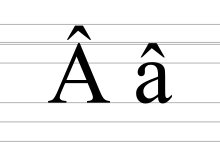
Latin letter A with circumflex
Â, â (a-circumflex) is a letter of the Inari Sami, Skolt Sami, Romanian, and Vietnamese alphabets. This letter as well appears in French, Friulian, Frisian, Portuguese, Turkish, Walloon, and Welsh languages equally a variant of the letter "a". Information technology is included in some romanization systems for Persian, Russian, and Ukrainian.
Berber languages [edit]
"â" can exist used in Berber Latin alphabet to represent [ʕ].
Emilian-Romagnol [edit]
 is used to represent [aː] in Emilian dialects, as in Bolognese câna [kaːna] "pikestaff".
Faroese [edit]
Johan Henrik Schrøter, who translated the Gospel of Matthew into Faroese in 1823, used â to denote a non-syllabic a, as in the following example:
| Schrøter 1817 | Modern Faroese |
|---|---|
| Brinhlid situr uj gjiltan Stouli, Teâ hit veâna Vujv, Drevur hoon Sjúra eâv Nordlondun Uj Hildarhaj tiil sujn. | Brynhild situr í gyltum stóli, tað hitt væna vív, dregur hon Sjúrða av Norðlondum í Hildarheið til sín. |
 is not used in modernistic Faroese, however.
French [edit]
⟨â⟩, in the French language, is used as the alphabetic character ⟨a⟩ with a circumflex accent. It is a remnant of Quondam French, where the vowel was followed, with some exceptions, past the consonant ⟨south⟩. For example, the modernistic form bâton (English: stick) comes from the Onetime French baston. Phonetically, ⟨â⟩ is traditionally pronounced equally /ɑ/, but is nowadays rarely distinguished from /a/ in many dialects such as in Parisian French. Still, the traditional ⟨â⟩ is nevertheless pronounced this way in Québecois French or Canadian French, which is known to resemble the phonetics of the Old French accent, and is widely spoken past French Canadians, the majority of whom live in the province of Québec.
In Maghreb French, ⟨â⟩ is used to transcribe the Standard arabic consonant ⟨ع⟩ /ʕ/, whose pronunciation is close to a non-syllabic [ɑ̯].
Friulian [edit]
 is used to correspond the /ɑː/ sound.
Inari Sami [edit]
 is used to represent the /ɐ/ sound.
Italian [edit]
 occasionally used to represent the sound /aː/ in words similar amârono (they loved).
Persian [edit]
 is used in the romanization of Persian to represent the sound /ɒ/ in words such as Fârs.
Portuguese [edit]
In Portuguese, â is used to mark a stressed /ɐ/ in words whose stressed syllable is nasal and in an unpredictable location within the word, as in "lâmina" (blade) and "âmbar" (amber). Where the location of the stressed syllable is predictable, such as in "ando" (I walk), the circumflex accent is not used. Â /ɐ/ contrasts with á, pronounced /a/.
Romanian [edit]
 is the 3rd letter of the Romanian alphabet and represents /ɨ/, which is also represented in Romanaian as alphabetic character î. The difference betwixt the ii is that â is used in the middle of the word, equally in "România", while î is used at the beginning and at the ends: "înțelegere" (understanding), "a urî" (to hate). A compound word starting with the alphabetic character î volition retain information technology, even if it goes in the center of the word: compare "înțelegere" (understanding) with "neînțelegere" (misunderstanding). Even so, if a suffix is added, the î changes into â, as in the case: "a urî" (to hate), "urât" (hated).
Russian [edit]
 is used in the ISO 9:1995 organization of Russian transliteration as the letter Я.
Serbo-Croatian [edit]
In all standard varieties of Serbo-Croatian, "â" is not a alphabetic character just simply an "a" with the circumflex that denotes vowel length. It is used just occasionally and so disambiguates homographs, which differ only past syllable length. That is nearly common in the plural genitive case and then it is too called "genitive sign": "Ja sam sâm" (English: I am alone).
Turkish [edit]
 is used to point the consonant earlier "a" is palatalized, as in "kâr" (profit). Information technology is likewise used to indicate /aː/ in words for which the long vowel changes the meaning, as in "adet" (pieces) and "âdet" (tradition) / "hala" (aunt) and "hâlâ" (still).
Ukrainian [edit]
 is used in the ISO nine:1995 system of Ukrainian transliteration to stand for the letter Я.
Vietnamese [edit]
 is the 3rd letter of the Vietnamese alphabet and represents /ɜ/. â /ɜ/ is a college vowel than plain a /ɑ/. In Vietnamese phonology, diacritics can exist added to course v forms to represent five tones of â:
- Ầ ầ
- Ẩ ẩ
- Ẫ ẫ
- Ấ ấ
- Ậ ậ
Welsh [edit]
In Welsh, â is used to stand for long stressed a [aː] when, without the circumflex, the vowel would be pronounced as short [a], e.1000., âr [aːr] "arable", as opposed to ar [ar] "on", or gwâr [ɡwaːr] "civilised, humane", rather than gwar [ɡwar] "nape of the neck". Information technology is often found in concluding syllables in which the messages occur twice a and combine to produce a long stressed vowel. That commonly happens when a verb stem ending in stressed a combines with the nominalising suffix -advertising, as in caniata- + -ad giving caniatâd [kanjaˈtaːd] "permission", and likewise when a singular substantive ending in a receives the plural suffix -au, as in drama + -au condign dramâu [draˈmaɨ, draˈmai] "dramas, plays". It is too useful in writing borrowed words with final stress, e.k. brigâd [brɪˈɡaːd] "brigade".
A circumflex is also used in the word â, which is both a preposition, meaning "with, by means of, as", and the 3rd person non-past singular of the verbal noun mynd "become". That distinguishes it in writing from the similarly pronounced a, meaning "and; whether; who, which, that".
Character mappings [edit]
| Preview | Â | â | ||
|---|---|---|---|---|
| Unicode proper noun | LATIN Capital letter A WITH CIRCUMFLEX | LATIN SMALL LETTER A WITH CIRCUMFLEX | ||
| Encodings | decimal | hex | dec | hex |
| Unicode | 194 | U+00C2 | 226 | U+00E2 |
| UTF-8 | 195 130 | C3 82 | 195 162 | C3 A2 |
| Numeric character reference | Â | Â | â | â |
| Named character reference | Â | â | ||
| ISO 8859-1/2/3/4/9/10/14/15/16 | 194 | C2 | 226 | E2 |
| EBCDIC | 98 | 62 | 66 | 42 |
Windows Alt Key Codes [edit]
â=Alt+0226, Alt+131 Â=0194
| Â | Alt | + | 0194 |
| â | Alt | + | 0226 |
|---|---|---|---|
| Alt | |||
| Alt |
[one]
TeX and LaTeX [edit]
 and â are obtained by the commands \^A and \^a.
In encoding mismatches [edit]
The capital  is sometimes seen on webpages when the page has been saved in an encoding different from that used to view it. The most common text encoding standard is Unicode, which encodes, for example, the copyright symbol © with the hexadecimal bytes C2 A9. In the older ANSI and ISO 8859-1 encoding standards, still, the © symbol is simply A9. If a browser is given the bytes C2 A9, intended to brandish © per the Unicode standard, but is led to parse the bytes according to ane of these older standards, it will interpret the bytes C2 A9 as 2 separate characters. C2 corresponds to Â, as seen in the nautical chart above, and A9 devolves to the © symbol, so the result seen by the person reading the folio is ©—that is, the correct © symbol merely with an  prepended. A number of characters—the characters in the Latin-1 supplement—accept Unicode encodings that are equal to their ANSI encodings but preceded by the byte C2, and then that when any of these characters is viewed in the incorrect encoding, an  will appear earlier it.[2]
Come across also [edit]
- Circumflex
References [edit]
- ^ Pyatt, Elizabeth J. "Windows Alt Key Codes". symbolcodes.tlt.psu.edu . Retrieved 2016-11-04 .
- ^ "firefox - Special graphic symbol 'Â' inserted before copyright symbol". Stack Overflow . Retrieved 2020-02-25 .
Source: https://en.wikipedia.org/wiki/%C3%82
0 Response to "Hamilton J Review of â€å“lower Oil Prices and the Us Economy Is This Time Different?ã¢â‚¬â"
Postar um comentário